
What is the Mexico Free Zone? The Real Map, the Real Rules, and the Mistake That Gets Cars Impounded

Here’s a scene that plays out at the border every single day. A driver rolls into Rosarito, windows down, completely confident they’re inside the Mexico Free Zone and don’t need a vehicle permit. They’re right — they don’t. Three months later, that same driver is sweating through a checkpoint near La Paz, suddenly unsure if the rules changed, if they missed something, or if they’re about to lose an afternoon arguing with a customs officer.
They didn’t do anything wrong. They just never learned exactly where the rules start and stop.
That’s the Mexico Free Zone in a nutshell: a real, legally defined stretch of the country where you can drive your U.S. or Canadian-registered vehicle without a Temporary Import Permit (TIP) — but only if you know precisely where its edges are, who it applies to, and which other rules it doesn’t touch. Get any one of those wrong, and “hassle-free” turns into a very expensive day.
So What Is the Mexico Free Zone, Exactly?
Strip away the legal language, and it’s simple: the Free Zone is a designated part of Mexico where the government has decided foreign-plated vehicles can come and go without the import paperwork normally required to bring a car into the country.
This isn’t a new idea, either. Mexico carved out its first “Zona Libre” back in 1858 — decades before anyone was driving anything — to keep trade and cross-border traffic moving. The boundaries and rules have shifted plenty since then, but the logic hasn’t changed: tourism goes up when you remove friction at the border. A vacationer who has to file paperwork and put down a deposit just to drive to Ensenada for the weekend might just decide to stay home instead. So the Free Zone exists to keep short regional trips simple, while the standard import rules stay firmly in place for anyone driving deeper into the country.
Where the Mexico Free Zone Actually Covers (More Than the Map You’ve Seen)
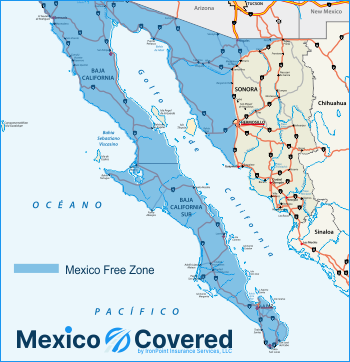
Inside any of these areas, you’re free to drive your foreign-plated vehicle without a TIP. The moment you cross outside one without a permit, you’re driving illegally — whether you meant to or not. And no, the zones don’t connect to each other. Quintana Roo, being a Free Zone doesn’t mean every state between there and the border is one too; you’d be driving through TIP-required territory to reach it.
Pro Tip:
In Sonora, there’s an actual marker for this: the Kilometer 98 sign near Empalme. Drive past it without a permit and you’re out of options — there’s no roadside fix. You’d have to turn around and go all the way back to the border. The one interior exception in Baja is the Banjercito office at the Pichilingue ferry terminal in La Paz, which exists specifically so travelers can get a TIP before boarding the ferry to mainland Mexico.
TIP or No TIP? Here’s How to Actually Decide
“Optional” is doing a lot of work in that sentence. A more useful way to think about it: get a TIP if there’s any real chance your trip leaves the zone, because you cannot get one once you’re past the border area.
A few things worth knowing before you decide either way:
- A standard TIP runs roughly $50 to $55, plus a refundable deposit based on your vehicle’s age and type.
- If you don’t properly cancel the TIP before leaving Mexico, you can lose that deposit — and complicate getting a permit on a future trip.
- Sticking to Sonora but venturing outside its Free Zone boundary? There’s a discounted “Sonora Only” permit instead of a full all-Mexico TIP.
- Planning to ferry from Baja to the mainland? You’ll need to stop at the Pichilingue Banjercito office in La Paz first — it’s the only place inside the interior where a TIP can be issued.
If you’d rather handle it before you’re standing at a counter, you can apply for a TIP online in advance through Banjercito, the only agency authorized to issue them.
The Permanent Resident Plot Twist (and a Few Other Curveballs)
Most Free Zone confusion comes from a handful of edge cases. Here are the ones worth knowing before you’re the one explaining yourself at a checkpoint.
Permanent residents can’t get a TIP — ever. Since a 2012 immigration law reform, Mexican law has barred anyone holding Residente Permanente status from applying for a Temporary Import Permit. That means a permanent resident’s only legal option for driving a foreign-plated car is staying inside a Free Zone, full stop — they can’t take it past the border buffer or into mainland Mexico under any circumstances.
Here’s where it gets messy: in late 2025, checkpoints near La Paz in Baja California Sur began stopping permanent residents and, in some cases, seizing vehicles — even from drivers who were doing everything correctly by staying inside the Mexico Free Zone. Lawyers who looked into it confirmed nothing in the actual law had changed; it appeared to be a localized enforcement pattern rather than a new rule, and there were no similar reports out of Baja California, Sonora, or Quintana Roo. The takeaway isn’t “the rules changed.” It’s that paperwork being technically correct doesn’t always prevent friction at a checkpoint — so keep your registration current and your documents on hand regardless of how confident you are in your rights.
A couple of other curveballs:
- Hybrids and EVs get no exemption. Plenty of EV owners assume an electric vehicle skips the TIP requirement outside the Free Zone. It doesn’t — same rules apply.
- “Everyone does it” isn’t a legal defense. If your route has any chance of leaving the zone, the fact that other drivers skip the permit doesn’t change what happens if you get checked.
The Document Checklist (the Stuff a TIP Doesn’t Replace)
Skipping the TIP only removes one requirement — not all of them. Here’s everything else you still need, Free Zone or not. For the full breakdown of documents and immigration requirements for driving in Mexico, that’s worth a closer read, too. The short version:
1. A Valid Passport (or Passport Card)
Required by law for any foreign visitor. If you’re staying as a temporary resident instead, proof of legal residency works in its place. Either way, bring the original — authorities won’t accept a copy if you’re asked to show it.
Pro-Tip:
A passport card only covers land travel inside the Free Zone. Step outside it, and the card alone won’t cut it.
2. Your Forma Migratoria Múltiple (FMM)
This tourist permit applies everywhere in Mexico — Free Zone included — and you need to carry it on you the entire trip. You can apply for an FMM online ahead of time with a valid passport or passport card, which beats doing it at the border with a line behind you.
3. Mexico Auto Insurance
Mandatory for every driver, in every part of the country, Free Zone or not. More on why this one never goes away below.
4. A Valid Driver’s License
Keep it on you anytime you’re behind the wheel — same as anywhere else.
5. Current Vehicle Registration
Mexican authorities check this more than you’d expect, mostly to confirm the registration is current and matches the person driving. Let it lapse, and you’re risking impoundment over a paperwork issue that had nothing to do with the Free Zone.
6. A Temporary Import Permit (only if you’re leaving the zone)
Covered in detail above — get one before you cross the border if there’s any chance your route takes you past it.
Insurance Doesn’t Care Where You’re Driving
This is the part people consistently miss: the Free Zone changes exactly one requirement — the TIP. It does not touch Mexico’s insurance law, which applies the same whether you’re cruising Ensenada or driving through Mexico City.
Mexican law requires liability coverage from a Mexico-licensed insurer for every driver, every trip, no exceptions for staying inside a Free Zone. A U.S. or Canadian policy doesn’t satisfy that requirement on its own, and if you’re ever in an accident without it, you’re looking at a legal mess on top of whatever damage already happened. We cover the full picture of Mexico auto insurance and how to get coverage from an authorized Mexican insurance carrier — worth sorting out before you cross, not after something goes wrong.
Three Myths About the Free Zone That Need to Die
Myth 1: “Free Zone” means no rules at all. It means no TIP. Your passport, FMM, insurance, and registration requirements never went anywhere.
Myth 2: A passport card works everywhere in Mexico. It works for land travel inside the Free Zone. Outside it, you need a full passport.
Myth 3: If a rule is inconvenient, it’s probably not enforced. Ask any permanent resident who got stopped near La Paz in 2025 how that assumption worked out.
The Bottom Line
The Mexico Free Zone is exactly what it sounds like: less hassle, not zero rules. Know where the boundaries actually sit — including the Quintana Roo zone most guides skip — keep your documents current, and treat insurance as non-negotiable no matter which side of the TIP line you’re on. Get those right, and the only thing slowing you down on your next trip is deciding where to eat first.

Quote & Buy Mexico Insurance
Choose the Mexico insurance coverage you need — fast, easy, and secure.
Mexico Vehicle Insurance




Mexico Property Insurance



Frequently Asked Questions about the Mexico Free Zone
Quote & Buy Mexico Auto Insurance Online

You can quote & buy Mexico Tourist Auto Insurance online. Offered through authorized A+ Rated Mexican insurance carriers.
Call today and speak with a professional insurance agent.